Eye-Tracking and Colored Overlays for Supporting Children with Dyslexia
Dyslexia is a language disorder that, in Serbia, affects as many as 95,000 school-age children according to statistical estimates. This disorder has a profound impact on reading ability, which can negatively affect school, emotional, and social aspects of life. As dyslexia can manifest itself in different ways, an individual approach allows for the best results. Changing the text presentation method is one approach that can greatly alleviate dyslexic reading difficulties.
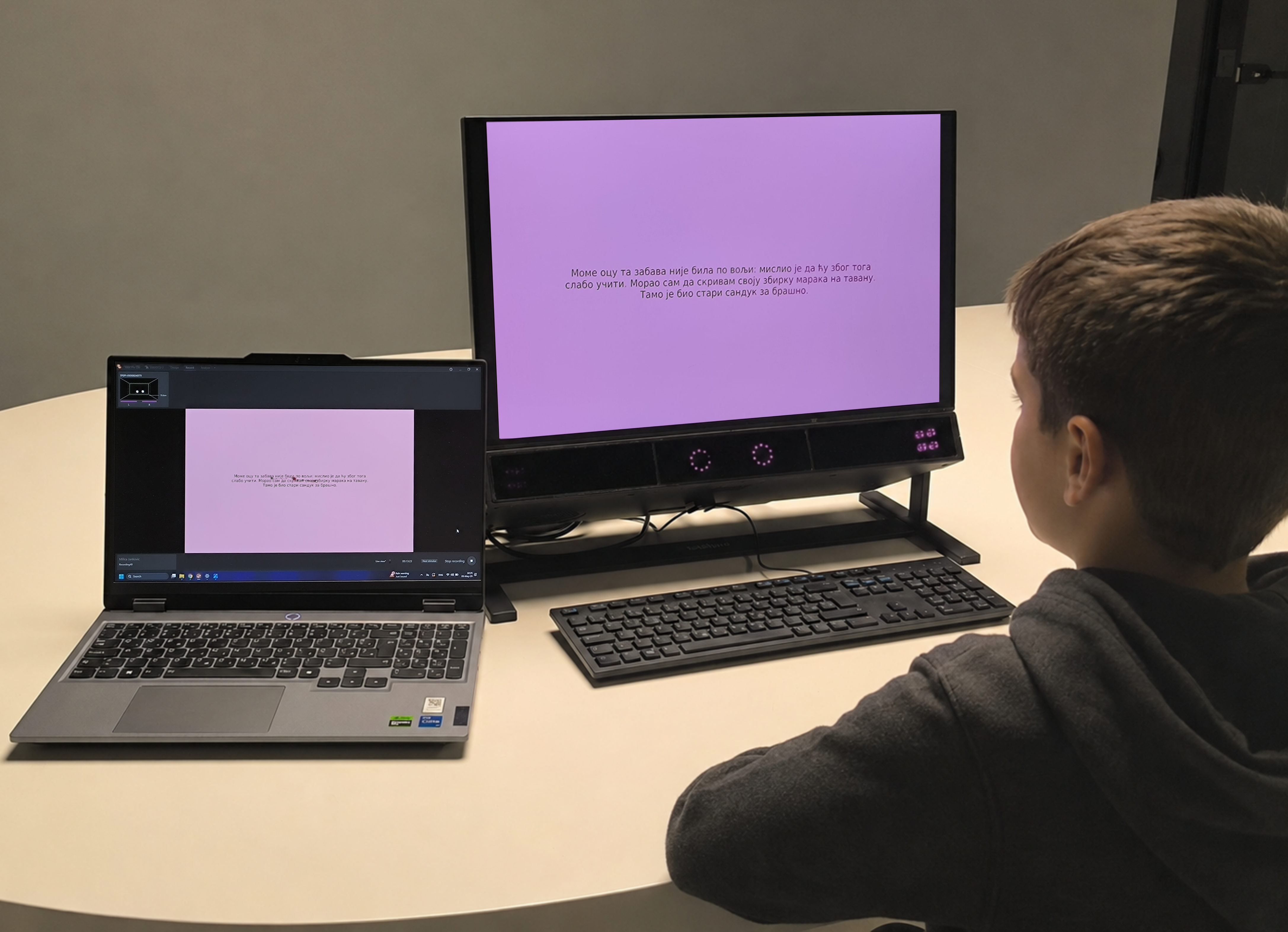
Within the colorDCD project, an adaptive tool was developed to support children with dyslexia through digital coloured overlays and eye-tracking technology. The project combined expertise in dyslexia, psychology, education, engineering, signal processing, and artificial intelligence to create a system that objectively assesses reading difficulties and recommends personalised text presentation settings.
The project was successfully completed and validated through two phases of experimental testing with elementary school children with dyslexia. The system automatically presented age-appropriate texts with different coloured overlays, recorded eye movements, analyzed conventional and novel eye-tracking features, and generated individual recommendations.
A software platform, data analysis tools, experimental dataset and personalized recommendation algorithm were all implemented as part of the PoC. The results confirmed that the system can identify colour configurations that improve reading performance in cases where stable individual preferences are present, supporting the idea that eye-tracking data can be used for objective and personalized reading assistance.
The project was financed within the Proof of Concept program of the Science Fund of the Republic of Serbia, #14948, supported by the SAIGE project of the World Bank.